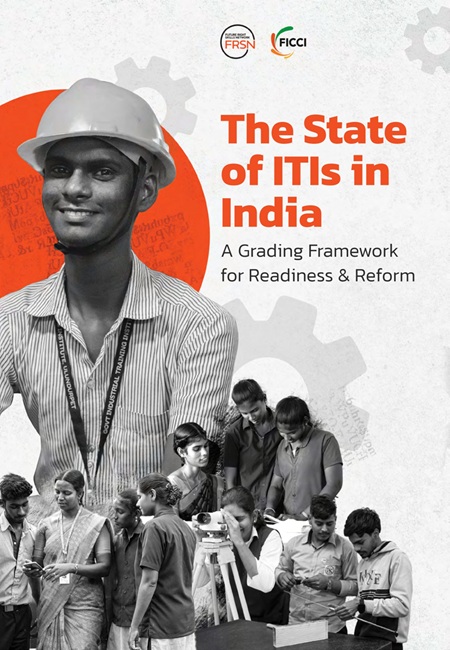
The State of ITIs in India A Grading Framework for Readiness & Reform
Industrial Training Institutes (ITIs) remain a key component of India’s skill development framework, contributing significantly to preparing young people for employment and sustainable livelihood opportunities. As the country strengthens its ambition to emerge as a global centre for manufacturing and services, increasing attention is being directed towards improving institutional effectiveness, deepening industry engagement, and enhancing trainee employability.
This knowledge paper presents a structured grading framework for ITIs that shifts the emphasis from traditional input-focused parameters towards outcome-oriented assessment. The framework examines dimensions such as learner preparedness for the workplace, the strength of industry linkages, and the overall functioning of training institutions. Developed through consultations with a diverse set of stakeholders and supported by analytical evidence, it provides insights into how ITIs are adapting to evolving labour market requirements.
Drawing on feedback from learners, alumni, employers, and institutional leadership, the framework seeks to support informed decision-making and enable comparative assessment across states. It also underscores the importance of closer industry collaboration, periodic curriculum updates, continued faculty development, and enabling governance mechanisms to strengthen training delivery and improve placement outcomes.
Overall, the framework is intended to serve as a practical reform instrument supporting institutional improvement and strengthening India’s vocational education system.
Key Takeaways
- ITIs are central to India’s workforce development strategy and support inclusive economic growth.
- There is a need to move beyond infrastructure and enrolment metrics towards measuring employability outcomes and industry relevance.
- The proposed framework evaluates ITIs across three broad focus areas: Youth readiness and future-ready skills, Industry partnerships and labour market alignment, Institutional governance and training quality.
- Multi-stakeholder data inputs enable more credible assessment and actionable insights.
- Strengthening ITI-industry collaboration can improve curriculum relevance, apprenticeships, and placement opportunities.
- Institutional autonomy, leadership capacity, and responsive financing remain key enablers of sustainable reform.
- The framework supports state-level benchmarking, resource prioritisation, and identification of high-impact interventions.
- Focusing on emerging sectors such as digital technologies, green jobs, and advanced manufacturing will be increasingly important for future workforce competitiveness.
- The grading framework is intended to function as a continuous improvement mechanism, not a compliance or ranking exercise.