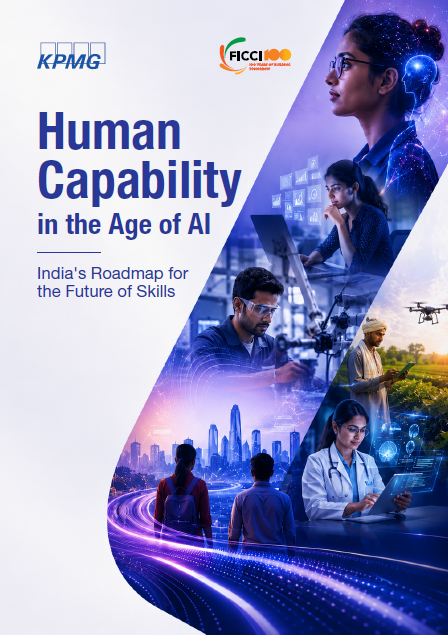
Human Capability in the Age of AI
Human Capability in the Age of AI examines how Artificial Intelligence is reshaping the nature of work across key sectors of India and what this transformation means for the future workforce. The report moves beyond the conventional debate around job replacement and highlights three broad pathways through which AI is influencing work, automation, augmentation and the continued importance of human capabilities. It demonstrates that AI is primarily transforming specific tasks within occupations rather than eliminating entire professions.
Across sectors including BFSI, healthcare, IT, manufacturing, retail and education, routine and codifiable activities are increasingly exposed to automation, while AI is augmenting workers by improving productivity and enabling them to focus on higher-value responsibilities. At the same time, roles centred on judgement, creativity, empathy, leadership, communication, trust and contextual decision-making remain strongly human-led.
The report therefore advocates a dual-skilling approach, where AI and digital proficiency are developed alongside human-centric capabilities. India has established a strong foundation through initiatives such as Skill India, FutureSkills Prime, PMKVY, YUVAi, SOAR and the IndiaAI Mission, but the next phase requires greater integration of technical and human capabilities within a common skills architecture.
The report ultimately positions human capability, strengthened by AI, as a critical foundation for India’s inclusive and future-ready growth.
Key Takeaways
- AI is transforming tasks, not simply replacing jobs: The report finds that augmentation is likely to affect a far larger share of work than complete automation. Workers will increasingly collaborate with AI rather than be fully substituted by it.
- Human capabilities are becoming more valuable: Critical thinking, creativity, empathy, communication, leadership, ethical reasoning, trust and contextual judgement remain difficult to replicate and are becoming important differentiators in an AI-enabled workplace.
- Every sector will experience a different form of transformation: AI is automating routine activities while augmenting professionals in healthcare, IT, manufacturing, retail and education. Human accountability, decision-making and relationship-based responsibilities continue to remain central.
- Dual-skilling is the core workforce imperative: Future workers will need AI literacy and technical skills alongside independent judgement, problem-solving, adaptability, communication and collaboration.
- Reskilling must be inclusive and continuous: India’s large and diverse workforce, including its substantial informal workforce, requires accessible and adaptable skilling pathways across sectors and geographies.
- Human–AI collaboration should be the goal: The report’s central message is that AI and human capabilities should be treated as complementary rather than competing priorities. India’s advantage will depend on how effectively it combines technological fluency with human judgement, creativity, resilience and adaptability.